Tag Archives: Hummingbirds

Hummingbirds due to make spring return


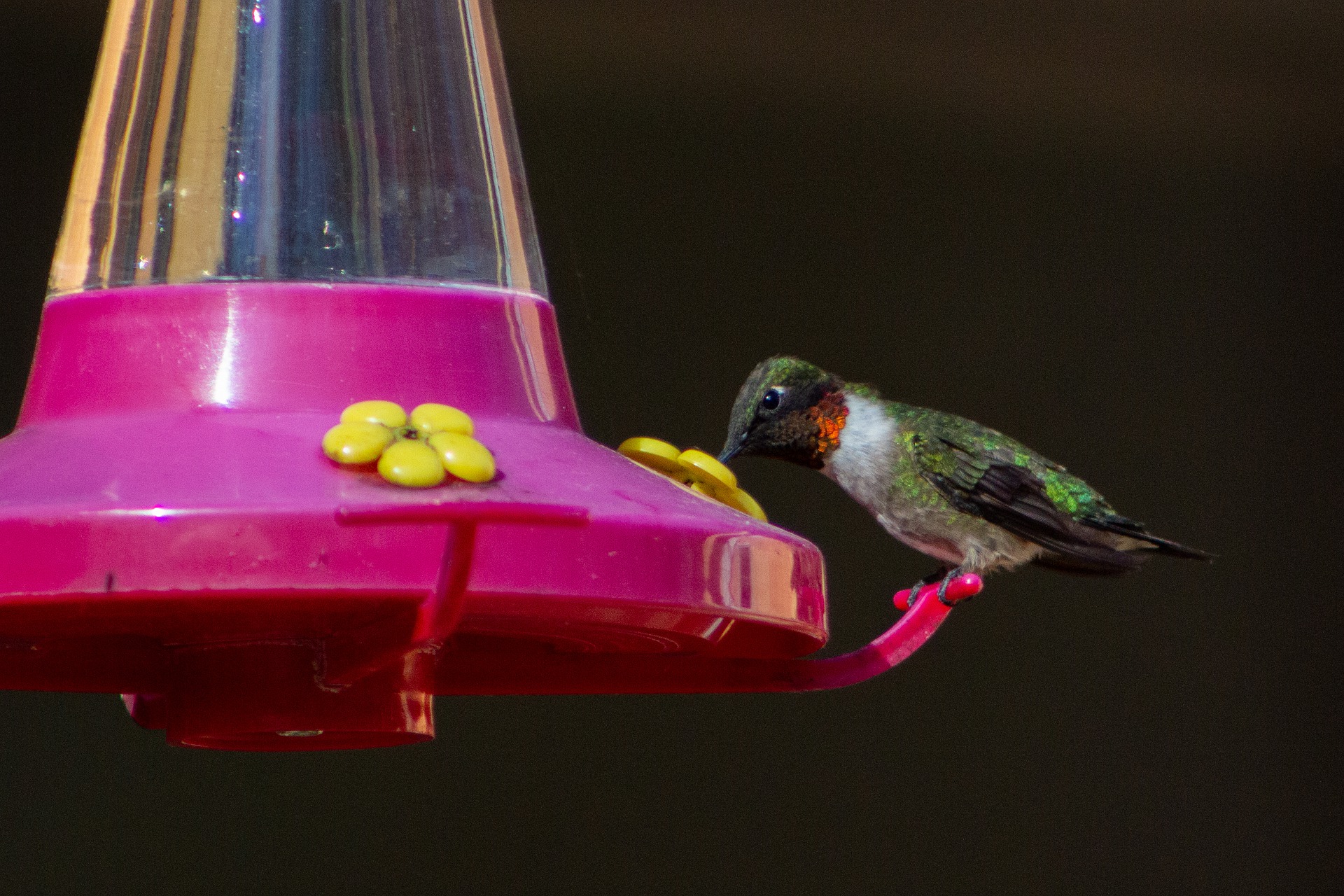
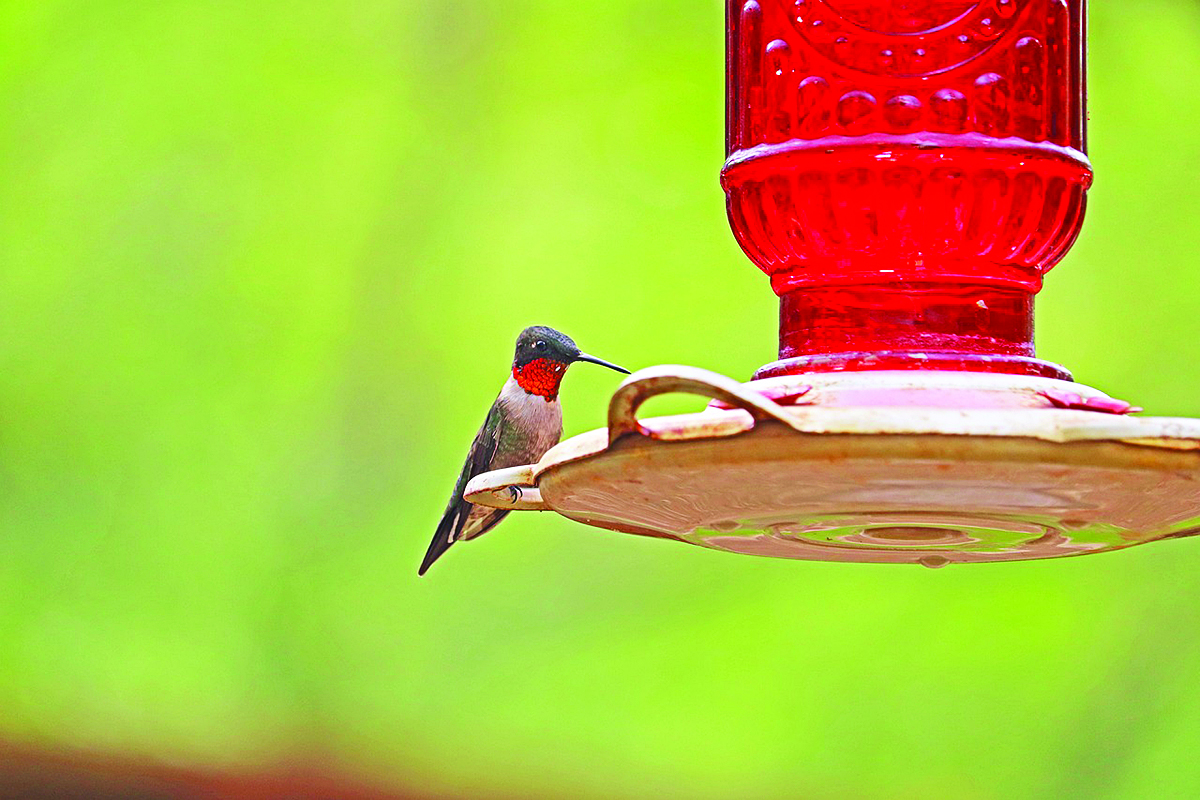
Photo by George from Pixabay • A male ruby-throated hummingbird obtains a dainty perch on a feeder offering sips of sugar water.

On March 4, Nancy Sheehan, a program coordinator for the Journey North website that tracks the migration of hummingbirds, as well as other wild creatures, posted on the project’s website.

“A small number of reports indicate that spring migrating hummingbirds are slowly arriving in southern regions of the United States,” she wrote.

In her post, she also wondered how weather patterns are impacting the pace of migration along the west coast?

That’s an interesting aspect of Journey North. The project tracks migration in both the eastern and western halves of the nation.

Sheehan noted that in the eastern United States, the annual migration of ruby-throated hummingbirds is proceeding pretty much on schedule.

“A small number of reports indicate that spring migrating hummingbirds are slowly arriving in southern regions,” Sheehan wrote. “It is time to put your feeders and potted nectar plants out. These nectar sources provide crucial energy for migrating hummingbirds. Depending on your location, start planting brightly colored native flowers to provide pollinator habitat for hummingbirds and other species such as monarch butterflies. Don’t delay – hummingbirds are here in many locations in the southern U.S.”

It’s fun to monitor hummingbird progress at Journey North, which also tracks the arrival of different hummingbird species in the western United States. There the first arrivals could include Allen’s, Anna’s, Broad-tailed, Black-chinned, Costa’s, Rufous and Allen’s hummingbirds.

I fully expect that ruby-throated hummingbird migration will bring the first individuals to Northeast Tennessee, Southwest Virginia, and Western North Carolina in early April if not late March. It’s even possible there will be some Easter arrival of hummingbirds in the region.

Most first spring observations of hummingbirds are males, although a few females are also early arrivals. Male hummingbirds arrive first so they can find and defend a territory.

As always, spring migration can be a challenging time for hummingbirds. Temperature, wind patterns and storms can influence the pace of migration.

Even once these tiny birds make their epic spring crossing of the Gulf of Mexico, they will need time to rest and refuel before moving northward.

By mid-March, the advance of ruby-throated hummingbirds has usually reached states such as Georgia and South Carolina. By the end of March, these tiny flying gems have reached states such as Tennessee and North Carolina.

It’s time to get those sugar water feeders outside and waiting for the early arrivals. Once the chance of late-season freezes has passed, consider planting some colorful native flowers to provide nectar sources for hummingbirds. In addition, some hanging baskets of flowers can be purchased from garden centers with the benefit that these baskets can be brought indoors during unseasonable cold snaps.

Northeast Tennessee usually gets its first spring hummingbirds the first week of April. If you’re seeing hummingbirds, I’d love to know. I have tracked arrivals for several years now. To share your first spring sighting of a ruby-throated hummingbird, email me at ahoodedwarbler@aol.com or contact me on Facebook at http://www.facebook.com/ahoodedwarbler. Please include the date and time of your sighting. I also welcome the sharing of other details about your sightings.

In the meantime, take steps now to welcome hummingbirds back and keep them safe during their stay.

Most experts also suggest avoiding red dyes or food colorings, which are often found in commercially marketed hummingbird sugar water. Don’t risk the health of hummingbirds for a little convenience.

It’s easy to make your own sugar water mix, which can be stored in the refrigerator in an empty plastic juice jug. Boil some water and then add one cup of sugar for every four cups of water in your pot. Stir thoroughly. Bottle the mixture until it cools. Fill your feeders and store any remaining sugar water in the fridge in the aforementioned jug. Refrigerated, the mix should stay good to use for at least a week.
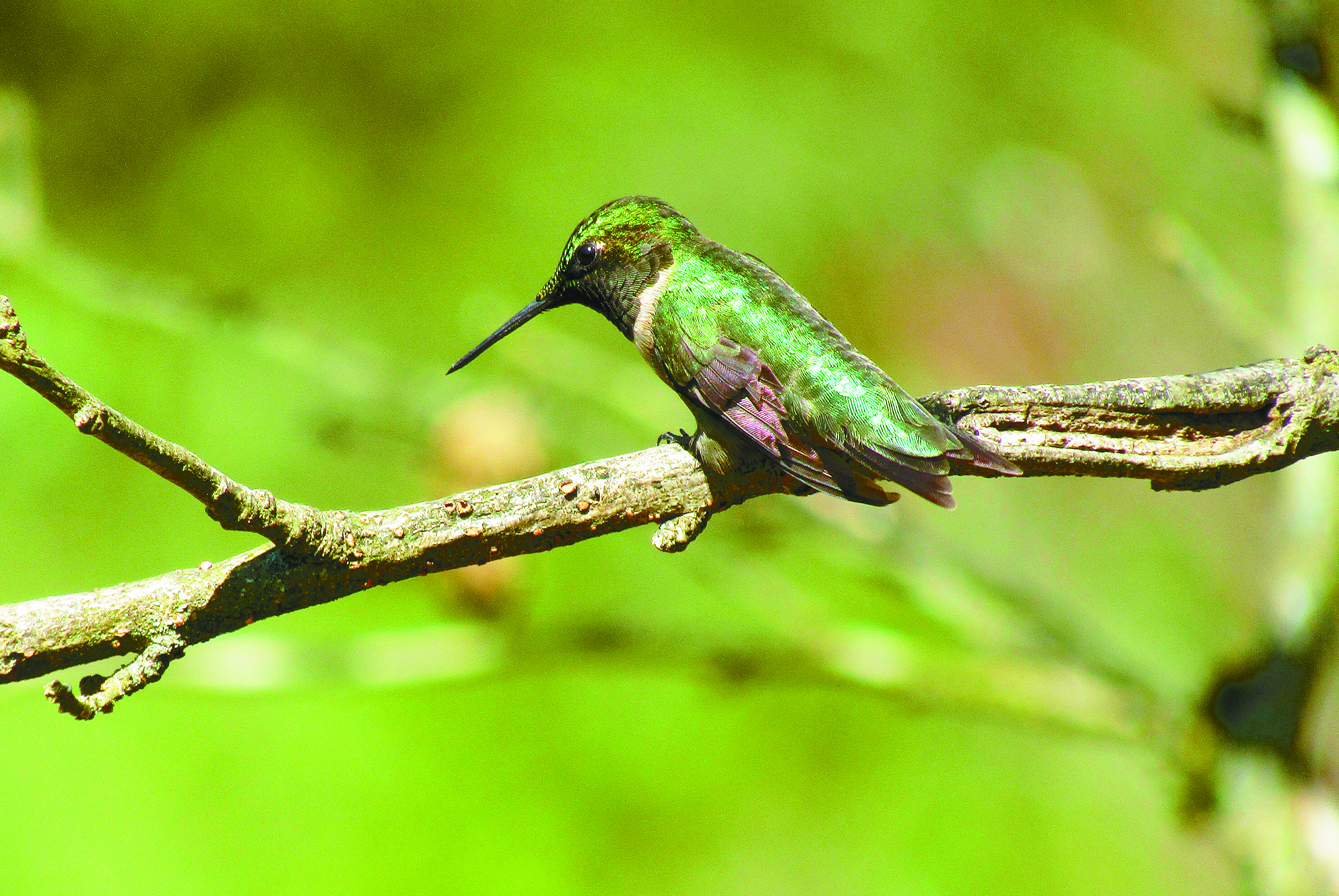
Photo by Bryan Stevens • A male ruby-throated hummingbird surveys his domain.

In our milder spring weather, changing the sugar water in feeders can probably be done on a weekly basis. When hotter summer temperatures prevail, it’s usually necessary to change the sugar water every two or three days.

Some ways of ensuring that our hummingbird guests are kept healthy and secure are simply common sense. For instance, don’t use pesticides, herbicides or any other sort of toxin anywhere close to the vicinity of a sugar water feeder or a flower garden. Hummingbirds are such tiny creatures with such intense metabolisms that it only takes a small amount of any harmful substance to sicken or kill one of these little flying gems.

For emphasis, I’ll repeat again that only common, pure cane sugar is safe for hummingbirds. There are no safe substitutes. Do not use organic, raw or brown sugar. Confectioner’s sugar, which contains an anti-caking substance (often corn starch, silicates or stearate salts), is also hazardous to hummingbirds.

The ratio of four parts water to one part sugar utilizing pure cane sugar most closely duplicates the nectar that hummingbirds obtain from some of their favorite flowers. Why try to mess with nature’s perfection?

I cannot imagine why anyone would supplement sugar water for hummingbirds with such human beverages as a sports drink or Kool-aid, but there have been reports of people doing so. Be aware that such additives will only risk the health of these tiny birds.

•••

Remember to send me those first sightings of returning spring hummingbirds. I’ll be doing my usual roundup to share who gets graced with a visit from one of these tiny beauties.

Readers share recent hummingbird observations as summer draws to a close

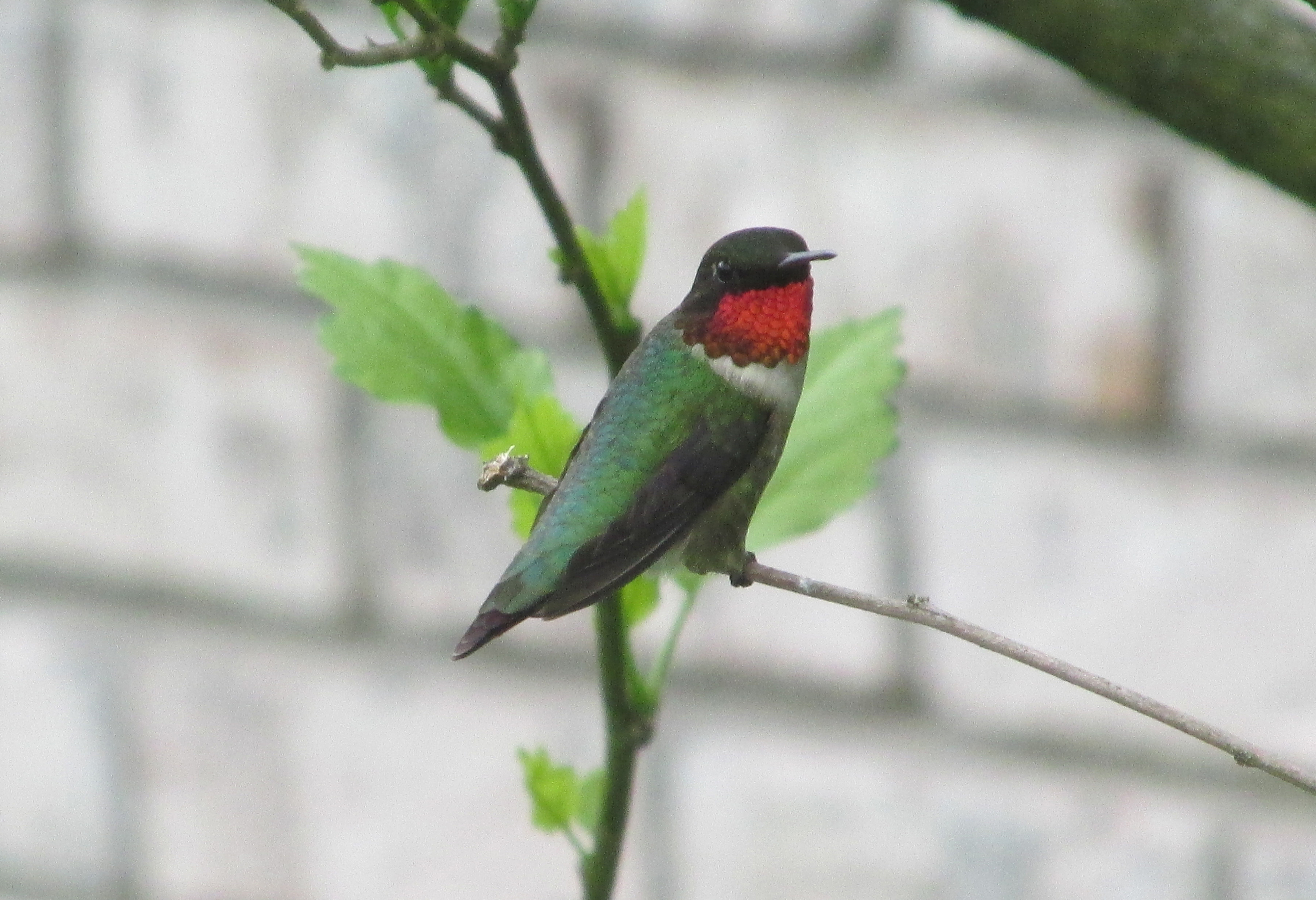
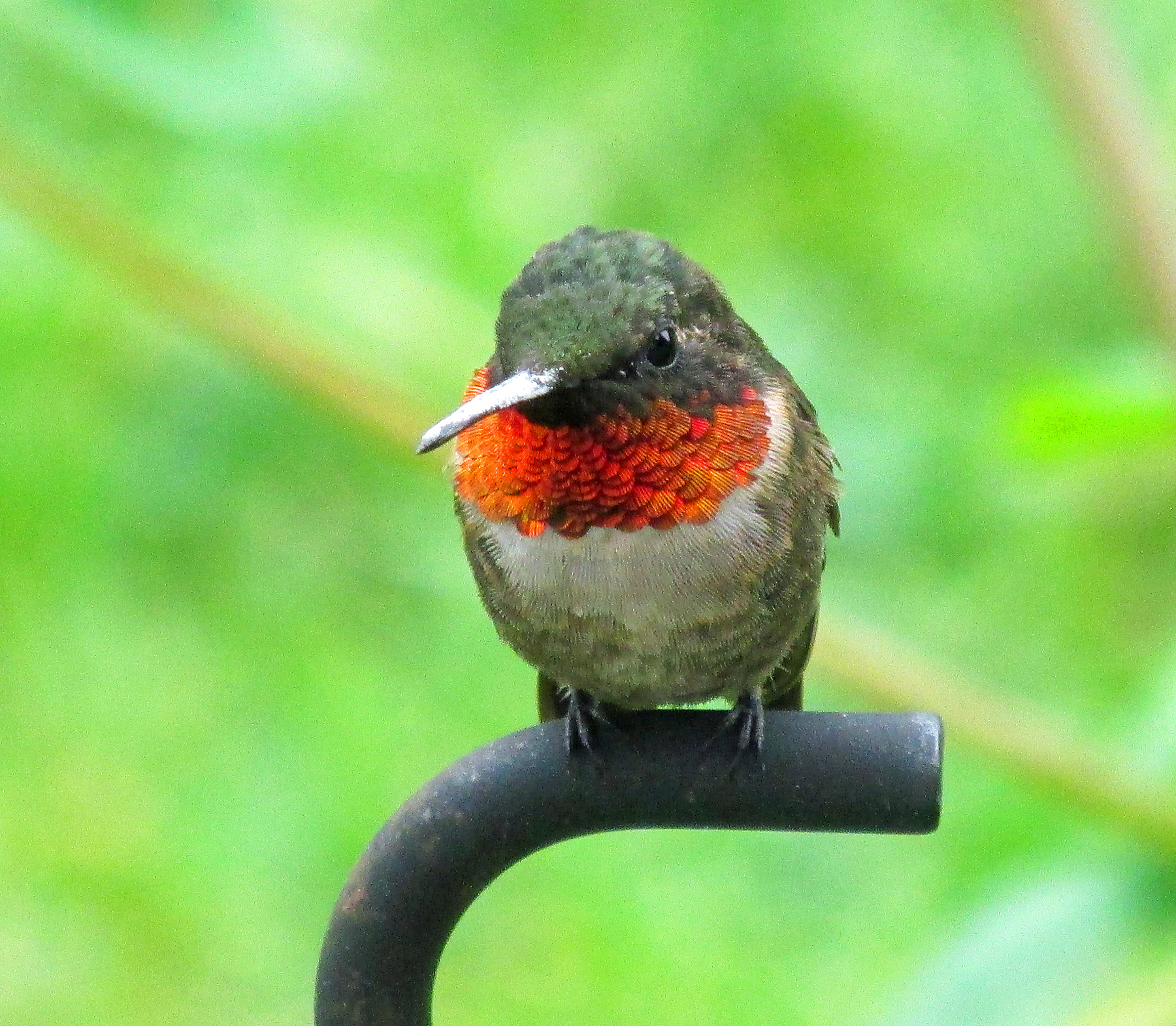
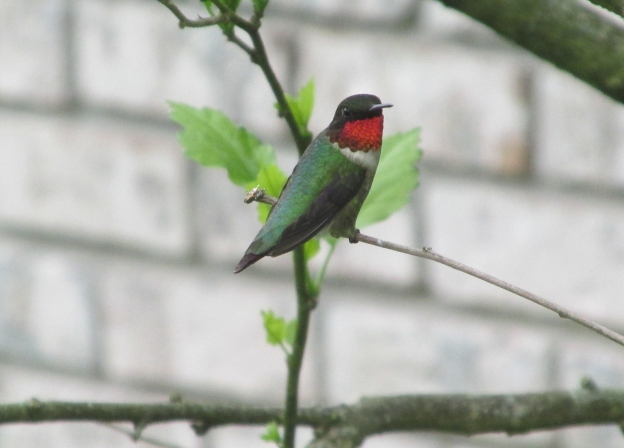
Photo by Bryan Stevens • The bright red throat patch, or gorget, of a male ruby-throated hummingbird makes the bird stand out. Female and young hummingbirds lack the bright throat color on the throat.

For the past week or so, I cannot step onto my front porch without hearing the whir of hummingbird wings or the twitters of this tiny bird’s fussy vocalizations.

I had written about hummingbirds recently, which prompted several readers to share some of their own stories or ask questions about these birds.

Laurie Philhower posted a comment on Facebook after reading my recent column about hummingbirds.

“I live in Middle Tennessee,” she noted. “I have five hummingbird feeders out, and they are full every day.”

I have the same number of feeders filled and available at my own home, and I’ve had no shortage of hummingbirds eager to line up for sugary sips.

•••

Carole Franklin also commented via Facebook after reading the column on hummingbirds.

“My feeder has been more busy the last couple of weeks than it has all summer,” she wrote. “Keep looking for different ones in the mix. I keep the feeder filled and fresh until the first freeze. Then put it back out afterwards just in case.”

I applaud Carole for her diligence. Every autumn, some western hummingbirds venture into the region. To date, species such as rufous hummingbird and Allen’s hummingbird have been documented. They are, however, almost always present at a location with a hummingbird feeder.

•••

Photo by Bryan Stevens • A male ruby-throated hummingbird perches at a feeder for a sip of sugar water.

Jewel Bentley contacted me with an interesting question after reading the hummingbird column.

“I have read that we need to increase the amount of sugar in hummingbird feeders right before they begin their migration south. Is this true?”

I wrote back and suggested that she refrain from making the sugar formula stronger. The four parts water to one part sugar is a formula designed to imitate the sugar content of flower nectar. There’s really no need to boost it.

•••

Lorraine Henderson sent me an email regarding my column.

“Thanks so much for the information about hummingbirds,” she wrote. “I will plant some more flowers.”

Right now, my hummingbirds cannot get enough of the jewelweed in bloom along the edges of my yard. They love to visit the abundant tiny orange blooms on each jewelweed plant. The best thing about jewelweed is that it’s wild and springs up each year without any need of my assistance.

•••

I also heard from Paulette Calli, who emailed me from California.

“Just wanted to thank you for your wonderful article on these lovely birds,” Paulette wrote. “I was curious about their life as well as migration. I am in Southern California, and my neighbor and I sit outside in the early evening and watch them play. They sometimes get so close to our faces but never hurt us. I think they are thanking us for their birdbath and sugar water.”

Her thoughts on hummingbird gratitude make sense to me. I also enjoyed hearing about her hummingbirds hovering in her face.

I do think that hummingbirds, as well as other birds, are often just as curious about us as we are about them.

Photo by Bryan Stevens • A ruby-throated hummingbird visits a feeder for a sip of sugar water.

•••

I also received an email from John Rush in Dewey, Arizona.

“I think Central Arizona is one of the last places you’d expect for bird sightings,” he wrote.

But, he added, “if you feed them, they will come,” which is certainly true.

“Right now I am enjoying four species of hummingbirds: Anna’s, rufous, black-chinned and broad-tailed,” he wrote. “Sometimes as many as 20 at a time, letting me get so close that I can feel the wind on my face from their wings.”

John certainly has a yard that seems a magnet for birds.

“In my yard I have spotted Northern flickers, gila and ladderback woodpeckers, vermilion flycatchers, Western bluebirds, juncos, blue grosbeaks and many other species,” he wrote.

He added that he is visited daily by raptors, including red-tailed hawk, Cooper’s hawk and American kestrels, as well as the occasional great blue heron.

“Just down the road from my home I spotted a ferruginous hawk,” he noted.

At Lynx Lake, which is about 15 miles from his home, he had watched a pair of mated bald eagles almost weekly.

“So, as you can see, this is a great place to see so many birds,” he said. “It’s crazy! And I omitted quite a few.”

I wrote back and congratulated John for the diversity he enjoys at his Arizona home.

His location is ideal for hummingbirds. Many birders wanting to add hummingbirds to their life lists head to Arizona.

I confessed that I would love to see Anna’s and broad-tailed hummingbirds, two species that have so far evaded being added to my list.

•••

Linda Dabney from Louisville, Kentucky, also emailed me with an inquiry about whether all ruby-throated hummingbirds have the namesake ruby-red throat.

It’s a good question. I see many more female and young hummingbirds than adult males, yet it’s only those adult males that sport the bright red throat.

Females and young hummingbirds are still ruby-throated hummingbirds, but they lack the red throat patch, or gorget, that the males use to dazzle onlookers.

•••

Laura Huggins in Englewood, Tennessee, posted a comment on Facebook after reading the column.

“They come visit us often,” she said. “My husband and I enjoy them very much.”

Laura’s observation gets right to the heart of the appeal of these tiny birds. They are special visitors during their all-too-brief seasonal stay. In exchange for providing them with sips of sugar water, they offer us hours of entertainment and fun memories.

September’s going to see many more ruby-throated hummingbirds winging their way through East Tennessee, Southwest Virginia and western North Carolina. In the western United States, in states like California and Arizona, a similar migration schedule will take place. I hope some of these tiny voyagers stop and linger. Make the most of these final few weeks to enjoy their feisty attitudes and sizzling antics.

•••

Bryan Stevens has written about birds since 1995. To ask a question, make a comment or share a sighting, please email him at ahoodedwarbler@aol.com.

Photo by Bryan Stevens • Male ruby-throated hummingbird show the namesake red throat. The feathers on a male’s throat are iridescent, which means they can change when seen from different angles. In poor light, the ruby-red throat can look almost black.

Hummingbird season is approaching its peak

Photo by Bryan Stevens • Keep hummingbirds happy with a sugar water solution of four parts water to one part sugar.

Thomas Hood, who lives near Burnsville, North Carolina, shared a note about his summer hummingbirds.

“We have a bunch of ruby-throated (hummingbirds),” Thomas wrote in an email.

He noted that last year, he hosted as many as 40 individual hummingbirds. This year he estimates he has hosted as many as 20.

“Late visitors this year, but they put on a great airshow,” he added.

He said that he has two feeders up and two handheld ones that he uses to attract hummingbirds to his home in the North Carolina mountains.

Thomas also shared a video of his tiny flying visitors.

In a follow-up email, he noted that the hummingbird population continues to grow.

“We love the entertainment they provide,” he wrote. “After the big storm yesterday, we estimated there are now near 30.”

•••

Thomas’s email was another reminder that it has been a busy season for female hummingbirds. Those that have been successful with their nesting were able to fledge twin hummingbirds and encourage them to spread their wings and leave the nest.

For hummingbirds, it’s invariably two eggs per nest for some good reasons. First, the nest is so small — about the size of a walnut half-shell — that there is barely room for two eggs, let alone more. Second, once the young hatch, the nest has just enough room to accommodate them as they grow, fed well by their mother. Third, feeding two hungry young hummingbirds is a demanding task. A female hummingbird has to find enough food to fuel her own body and help her young in the nest grow and thrive. It’s a full-time job during the daylight hours. She’s pressed hard to succeed at raising two young. Attempting to care for more would most likely prove impossible.

Now that many female hummingbirds have finished the task of bringing forth a new generation of hummingbirds, the leisurely fall migration can begin.

Hummingbirds are not as frantic about moving south in the fall as they are single-minded about heading north every spring. Numbers of these birds always reach a peak in late summer and early fall at my home, and this year’s shaping up to be a repeat of past ones.

Hummingbird species number around 340, making the family second in species only to the tyrant flycatchers in sheer size. Both of these families consist of birds exclusive to the New World.

With so many hummingbird species, people have been hard pressed to give descriptive names to all these tiny gems. Some of the dazzling array of names include little hermit, hook-billed hermit, fiery topaz, sooty barbthroat, white-throated daggerbill, hyacinth visorbearer, sparkling violetear, horned sungem, black-eared fairy, white-tailed goldenthroat, green mango, green-throated carib, amethyst-throated sunangel, green-backed firecrown, wire-crested thorntail, festive coquette, bronze-tailed comet, black-breasted hillstar, black-tailed trainbearer, blue-mantled thornbill, bearded mountaineer, colorful puffleg, marvelous spatuletail, bronzy inca, rainbow starfrontlet, velvet-purple coronet, pink-throated brilliant, coppery emerald, snowcap, golden-tailed sapphire and violet-bellied hummingbird.

Photo by Bryan Stevens • Male ruby-throated hummingbird show the namesake red throat. The feathers on a male’s throat are iridescent, which means they can change when seen from different angles. In poor light, the ruby-red throat can look almost black.

Our own hummingbird, which we can claim from April through October every year, is the ruby-throated hummingbird. Ruby-throats are remarkable birds that nest throughout the eastern United States, as well as southern Canada. In winter, most ruby-throats withdraw to Central America and Mexico, although a few winter in Florida. They are famous for the amazing feat of crossing the Gulf of Mexico twice each year as they travel to their nesting grounds and then back to their overwintering homes.

The next generation of hummingbirds always helps swell the number of these tiny birds in our yards in late summer and early fall. It’s our duty as hosts to keep them safe as they stop in our yards and gardens during their fall migration. Many of the hummingbirds in the fall will be making their first migration, so they will need all the help we can provide to make a successful journey.

Perhaps consider enhancing your plantings of summer flowers while also continuing to offer multiple sugar water feeders. Keep the sugar water mix at a four parts water to one part sugar ratio. Don’t offer honey in your feeders. When mixed with water, it can spoil and spread fungal diseases.

Remember that hummingbirds don’t subsist on sugar water alone. They also eat numerous tiny insects and spiders to obtain the protein they need for their dietary needs, so don’t use insecticides near feeders or flowers that hummers are likely to visit.

So, until October frosts eventually drive them out of the region, enjoy the ruby-throated hummingbirds while you can.

•••

Bryan Stevens has written about birds since 1995. Share a sighting, make a comment or ask a question by emailing him at ahoodedwarbler@aol.com.

Photo by Bryan Stevens • A ruby-throated hummingbird lifts its wings to shake water droplets off its back.

Share your first sightings of spring hummingbirds

Photo by Georgia Lens / Pixabay

The website Journey North noted in a post on March 15, that hummingbird migration along the Pacific Coast has been impacted by the crazy weather that California has experienced in recent weeks.

In the eastern United States, however, the annual migration of ruby-throated hummingbirds is proceeding pretty much on schedule.

According to Journey North, volunteers along the Gulf Coast and in the Southeast have been reporting arriving ruby-throated hummingbirds since early March.
I fully expect that ruby-throated hummingbird migration will bring the first individuals to Northeast Tennessee, Southwest Virginia, and Western North Carolina in early April.

Photo by Bryan Stevens • Male ruby-throated hummingbird show the namesake red throat. The feathers on a male’s throat are iridescent, which means they can change when seen from different angles. In poor light, the ruby-red throat can look almost black.

According to the website, most first spring observations of hummingbirds are males, although a few females are being spotted. Male hummingbirds, the posting noted, arrive first so they can find and defend a territory.

As always, spring migration can be a challenging time for hummingbirds. Temperature, wind patterns and storms can influence the pace of migration.
Even once these tiny birds make their epic spring crossing of the Gulf of Mexico, they will need time to rest and refuel before moving northward. By mid-March, the advance of ruby-throated hummingbirds has usually reached states as Georgia and South Carolina. By the end of March, these tiny flying gems have reached states such as Tennessee and North Carolina.

It’s time to get those sugar water feeders outside and waiting for the early arrivals. Once the chance of late-season freezes has passed, consider planting some colorful native flowers to provide nectar sources for hummingbirds.

Northeast Tennessee usually gets its first spring hummingbirds the first week of April. If you’re seeing hummingbirds, I’d love to know. I have tracked arrivals for several years now. To share your first spring sighting of a ruby-throated hummingbird, email me at ahoodedwarbler@aol.com or contact me on Facebook at http://www.facebook.com/ahoodedwarbler. Please include the date and time of your sighting. I also welcome the sharing of other details about your sightings.
In the meantime, take steps now to welcome hummingbirds back and keep them safe during their stay.

Some ways of ensuring that our hummingbird guests are kept healthy and secure are simply common sense. For instance, don’t use pesticides, herbicides or any other sort of toxin anywhere close to the vicinity of a sugar water feeder or a flower garden. Hummingbirds are such tiny creatures with such intense metabolisms that it only takes a small amount of any harmful substance to sicken or kill one of these little flying gems.

Feeding hummingbirds is easy, but many people try to complicate the process. Only common, pure cane sugar, mixed to a ratio of four parts water to one part sugar, is a safe choice for these birds.

For emphasis, I’ll repeat again that only common, pure cane sugar is safe for hummingbirds. There are no safe substitutes. Do not use organic, raw or brown sugar. Confectioner’s sugar, which contains an anti-caking substance (often corn starch, silicates or stearate salts), is also hazardous to hummingbirds.
The ratio of four parts water to one part sugar utilizing pure cane sugar most closely duplicates the nectar that hummingbirds obtain from some of their favorite flowers. Why try to mess with nature’s perfection?

I cannot imagine why anyone would supplement sugar water for hummingbirds with such human beverages as a sports drink or Kool-aid, but there have been reports of people doing so. Be aware that such additives will only risk the health of these tiny birds.

Photo by Bryan Stevens • Despite a perceived disadvantage of size, ruby-throated hummingbirds are quite capable of thriving in a giant world.

Most experts also suggest avoiding red dyes or food colorings, which are often found in commercially marketed hummingbird sugar water. Don’t risk the health of hummingbirds for a little convenience.

It’s easy to make your own sugar water mix, which can be stored in the refrigerator in an empty plastic juice jug. Boil some water and then add one cup of sugar for every four cups of water in your pot. Stir thoroughly. Bottle the mixture until it cools. Fill your feeders and store any remaining sugar water in the fridge in the aforementioned jug. Refrigerated, the mix should stay good to use for at least a week.

In our milder spring weather, changing the sugar water in feeders can probably be done on a weekly basis. When hotter summer temperatures prevail, it’s usually necessary to change the sugar water every two or three days.

•••

Remember to send me those first sightings of returning spring hummingbirds. I’ll be doing my usual roundup to share who gets graced with a visit from one of these tiny beauties.

Sightings signal that migration has started

Photo by Bryan Stevens • Ruby-throated Hummingbirds make a non-stop crossing of the Gulf of Mexico. A hurricane in the Gulf during migration could have serious consequences for this small bird.

Mack Hayes, a resident of Telford, posted on my Facebook page recently about hummingbird experiences. 

“I have two hummingbird feeders out, and boy are they really working them,” Mack wrote. “I see several of them, and of course they fight each other. Males and females both. Guess they are getting ready for their long flight  ahead of them.”

Mack’s post reminded me that many of our favored summer visitors will soon make their return migrations to regions more hospitable for the duration of the winter season.

I replied to his post with my own comment.

“I am sure they are getting ready, but I still hope they don’t get in too great a hurry. I would like to keep them with us as long as possible.”

At home, I have enjoyed some fun bird observations. It was a veritable feeding frenzy in a corner of my yard for about an hour on Tuesday, Aug. 10. Everything kicked off with a Red-eyed Vireo enjoying some elderberries. I was reminded that, with a really good look, the Red-eyed Vireo should never be mistaken for a warbler. That bill is so much bigger than a warbler bill! I was watching the vireo in binoculars when he coughed and popped up an elderberry. He immediately swallowed it again! Waste not, want not, I suppose. 

I am counting this burst of bird activity as the official kickoff for my fall migration watching.

I watched the vireo a long time before I realized there was a Gray Catbird perched lower in the shrub and also enjoying the elderberries. Then, in rapid succession, three warblers: Black-throated Green Warbler, Northern Parula and Worm-eating Warbler. On the fringes of all this activity I noticed a Brown Thrasher, Downy Woodpecker, a couple of Mourning Doves, and the resident Carolina Chickadees, Tufted Titmice and Carolina Wrens. 

I also saw some parents hard-pressed to satisfy their young, including a Blue-gray Gnatcatcher being followed and pestered by a couple of young gnatcatchers, and a male Eastern Towhee leading a youngster around on the ground as they foraged beneath the forsythia tangle. 

Photo Courtesy of Jean Potter
A red-eyed vireo sits on its basket-shaped nest.

At the feeders I saw American Goldfinches, Northern Cardinals, and several Ruby-throated Hummingbirds, which don’t know the meaning of the word “share” as they dived and attacked any of their fellow hummers that came too close to “their” feeder. All in all, a fun Tuesday evening.

The start of migration appears to be more of a crawl than a sprint this fall, but I have picked up a few additional signs. For instance, I’ve been hearing the scolding sounds of red-eyed vireos from woodland edges for the past few weeks even before I observed the vireo feeding on the elderberries. A dedicated singer at most times, this vireo seems more likely to produce a harsh, scolding cry at this time of the year. Other hints of the steady advance of fall migration include flocks of chimney swifts congregating in the skies over my home and the unmistakable croaking of common ravens from nearby ridges.

So far, I’ve seen only a few warblers. At a glance, vireos would appear related to the wood warblers. Research into DNA, however, has led many experts to contend that vireos are more closely related to crows and shrikes. Like the flycatcher and hummingbird families, the vireo family is exclusive to the New World. With a mere 50 species, vireos and their kin are vastly outnumbered by flycatchers and hummingbirds. The majority of vireos resides in the tropics, but about a dozen species nest in the United States.

In East Tennessee Southwest Virginia and Western North Carolina, vireos resident during the summer months include red-eyed vireo, white-eyed vireo, blue-headed vireo, yellow-throated vireo and warbling vireo. Most people are likely unaware of vireos. Although not uncommon, these birds are more frequently heard than seen. They spend much of their time in the forest canopy or in dense brush. When singing, they can remain at a perch, unmoving, for long periods of time.

Photo by Bryan Stevens • Blue-headed vireos, such as this bird, are high-elevation summer residents in the region. In the fall, they are also common migrants.

The loud scolding calls of red-eyed vireos often heard this time of year are given apparently when the vireo is alarmed or irritated. This scolding vocalization is quite unlike the usual ones produced by this bird. First and foremost, the call is louder than one would think could be produced by a bird that is only about six inches long. During the summer season, the red-eyed vireo is also one of the most persistent of singing songbirds. Another common name for the red-eyed vireo is “preacher bird,” so called because of its tendency to unceasingly deliver its song.

The red-eyed vireo is still considered one of eastern North America’s most common summer breeding birds. At one time, the red-eyed vireo was probably the most common breeding bird in eastern woodlands. That, sadly, is no longer the case. Red-eyed vireos are olive-green above and clean white below. These birds show a distinctive head pattern consisting of a gray crown and white eyebrow stripe bordered above and below by black lines. Adults also have the red eyes that give this particular vireo its common name. The term “vireo,” originating in Latin, can be translated into English as “green bird.” It’s an apt description, as many of these small birds are primarily dull green in coloration. Consider the vireos the “Plain Janes” of songbirds.

Some of the more colorful common names for vireos include the dwarf vireo, golden vireo and yellow-winged vireo.  In Central and South America, the vireo family expands to include many birds with common names such as shrike-vireo, greenlet and peppershrike. Some of the varied species include lemon-chested greenlet, green shrike-vireo and the black-bellied peppershrike.

I still focus most of my birding efforts on warblers in the autumn, but vireos are always a pleasant diversion when the colorful warblers make themselves scarce.

Keep your eyes open for new visitors. Those hummingbirds that scorned you this spring may give your home a second glance as they pass through this fall. In addition, the skies are filled with migrating raptors, flycatchers, thrushes, nighthawks and many other birds. 

Share sightings, ask questions or make comments by emailing me at ahoodedwarbler@aol.com. 

Getting ready for the spring migration of birds

It’s already the middle of March. While birds don’t follow calendars, they are punctual, and thanks to their boundless energies, the grand spectacle of spring migration is already upon us. The pace will quicken in April and early May as many of our favorite summer birds, including species ranging from hummingbirds and warblers to swifts and swallows, wing their way back to the region.

A few will stay, pair with a mate and begin the nesting season in earnest while others will continue toward destinations farther north. For fellow bird enthusiasts, now is the time to conduct some spring tasks to make our feathered friends feel more welcome when they do return.

Place birdhouses
Many birds are cavity-nesting species, which means they utilize natural nooks and crannies as locations for nests. Nesting in a natural tree cavity or in a human-provided birdhouse offers an extra degree of security not available to birds that build traditional cup-shape nests, not to mention all the birds that simply lay their eggs right on the ground without going to much effort to construct an actual nest.
Some of the cavity-nesting species in the region that will readily accept quarters in a bird house include Carolina chickadee, Eastern bluebird, white-breasted nuthatch, tree swallow, tufted titmouse, great crested flycatcher, prothonotary warbler and house wren.
Cavity-nesting isn’t restricted to songbirds. Wood ducks, Eastern screech-owls and American kestrels will make use of birdhouses built to their unique specifications.
Plans for constructing your own bird houses tailored to individual species can be found at various online sites. For those not as good with do-it-yourself projects, department stores, gardening centers and other other shops sell a variety of pre-made houses.

Put hummingbird
feeders out early
Journey North, a website that tracks the annual migration of hummingbirds as well as other wild creatures reports a slow start to the ruby-throated hummingbird spring migration. “Journey North citizen scientists in Texas and along the Gulf are noting arrivals, but reports are still few and far between,” notes an article on the website.
Reports had been received of a ruby-throated hummingbird in Fairhope, Alabama, on March 2, and another in Port O’Connor, Texas, on March 6.
However, Journey North reported February’s cold spell across much of the southern U.S. could have caused a delay in migration. To report first observations of migrating ruby-throated hummingbirds, visit journeynorth.org.
Whether they’re early, late or right on time, the hummingbirds are only weeks away. There will always be “early birds” even among hummingbirds. Increase the likelihood of seeing one of these tiny gems by putting out a sugar water feeder soon.
Remember to fill your feeder with a mixture of one part sugar to four parts water. Don’t add red coloring. Experts suspect that some dyes could be detrimental to hummingbird health. Why take the risk?

Clean feeders
This past winter saw large flocks of pine siskin, purple finch and evening grosbeak in some locations across the region. In some states, these large flocks also suffered from outbreaks of diseases, including salmonella.
As returning birds mingle with lingering winter visitors at our feeders this spring, the chance of spreading disease will increase.
Now is definitely the time to be proactive, cleaning feeders and bird baths regularly and keeping alert to any sign that ill birds might be among the visiting flocks.
Cleaning need not be laborious. Fill a spray bottle with a dilute solution of bleach water. A good ratio is no more than 1 part bleach to 9 parts water. Remove feeders, give them a quick rinse, and then spritz them with the bleach solution. Rinse thoroughly and allow to dry before refilling with seed for the birds.
Keep feeding the birds, but play the diligent host. Put out only the amount of seed that visiting birds can eat in a single day. Monitor the flocks for any sign of illness and respond quickly if such signs are detected.

Refurbish brush piles
This past winter with its heavy snow and ice, as well as fierce winds, no doubt brought down many branches. When cleaning your yard of branches, consider adding them to an existing brush pile. I’ve long been a fan of keeping a brush pile in order to provide the resident songbirds with shelter and security from the elements, as well as from predators.
If you don’t have a brush pile, spring’s the perfect time to create one. If an unkempt pile of sticks offends your aesthetic sensibilities, tuck the brush pile into an obscure corner or locate it at the margins of the lawn or garden.
Personally, I like to locate brush piles near my busier feeders. A brush pile gives visiting birds a quick retreat if a predatory hawk arrives unexpectedly. For some birds, the need for dense cover is paramount.
Offering brush piles, as well as hedges and dense shrubbery, will help welcome visitors such as gray catbirds, Eastern towhees, brown thrashers and some sparrows. Wide, open spaces make many songbirds nervous.

Install
water features
With a large fish pond, a flowing creek and a couple of mountain seeps on my property, I’ve never needed to introduce an additional water source. For those with properties that don’t offer ready access to water, adding an ornamental pool or fountain, or even a bird bath or artificial waterfall, will act as a magnet for many birds. American robins and cedar waxwings love a place to splish and splash, as well as take a refreshing sip. Migrating warblers, which for the most part ignore feeders, are almost magically drawn to water features.
There is also something relaxing for the human psyche when it comes to water features. Treat yourself as well as the visiting birds by adding one to your lawn or garden.

Make beneficial
landscape additions
Spring’s a great time to plan ahead. While a handout of sunflower seed is appreciated by many birds, there’s nothing that beats organic sources of food.
Add plants and trees to the landscape of your yard and garden with the express purpose of providing birds with seeds, fruits and berries. Most experts urge native plant varieties that meet the nutritional needs of many bird species.
Flowers can be chosen that provide that desired burst of color for an interval but then go on to produce fruit or seeds craved by many birds. Native flowers can also be planted that offer a natural source of nectar for ruby-throated hummingbirds. Do some homework. Some nurseries specialize in native plants.

Give yourself a treat
Now is also the perfect time to indulge in a purchase that will enhance your enjoyment of the returning birds. If you have been wanting a new pair of binoculars, a new software app to help identify birds or a camera to let you document bird sightings with photographs, there’s no time like the present.
Welcome spring and the returning birds at the same time while ensuring maximum enjoyment of both.

Photo by Pixabay.com • A good pair of binoculars will bring birds much closer.

Rufous hummingbirds appear after other hummers depart for the winter

Photo by Bryan Stevens • A young rufous hummingbird approaches a feeder for a sip of sugar water. These hummingbirds, which are native to the western United States and Canada, have become regular visitors throughout the eastern United States in late fall and early winter.

Almost every year since beginning to write this column, I have penned articles about the phenomenon of wintering hummingbirds. With the official 2020-21 winter season approaching, I have already gotten word of hummingbirds making themselves at a couple of homes in the region, as well as from such far-flung locales as Ohio and New York.

Photo by U.S. Fish & Wildlife Service/Dave Menke • The rufous hummingbird is increasingly becoming a migrant/winter resident in the eastern United States.

Katherine Noblet, a former resident of Johnson City, Tennessee, is hosting a rufous hummingbird at her home in Mount Vernon, Ohio. The tiny bird was banded and identified on Nov. 16. The verdict? The tiny visitor is a first-year female rufous hummingbird.

Noblet, who also hosted rufous hummingbirds when she lived in Tennessee, has posted on Facebook about her most recent winter hummingbird. She noted that the hummingbird, which she has named Reba, first appeared on Nov. 14. Temperatures have dipped into the 20s during the bird’s stay.

“Why a few of these tiny creatures want to hang around this far north is a mystery, but she looks happy and healthy and cannot be existing on just sugar water,” Noblet noted in a Facebook post on Nov. 24. “I have to trust she knows what she is doing.”

Closer to home, some Roan Mountain residents have reported lingering hummingbirds.

Leslie and Kathie Storie, who reside on Heaton Creek in Roan Mountain, Tennessee, posted to Facebook on Oct. 29 about a visiting hummingbird.

Photo by Bryan Stevens • A rufous hummingbird grasps a briar as a perch for a moment’s rest from its frantic activities.

“We had a hummingbird on Heaton Creek about 6 o’clock today,” they noted in a post on my Facebook page.

Although they had already taken down their feeders, they reported still having pineapple sage and lantana in bloom in their yard. These flowers are favorites of hummingbirds and would no doubt help attract one of these tiny birds.


Judi Sawyer, also a resident of Roan Mountain, has hosted not one but two rufous hummingbirds this fall. She noticed the birds in early October. One of the two birds was banded and documented on Oct. 4. One of the birds evaded the bander’s traps, but the one that was banded was identified as an immature male rufous hummingbird.

I also received an email recently from Susan Jensen, a resident of Carmel, New York, about a lingering hummingbird at her feeders. She had found one of my online articles about wintering hummingbirds and contacted me for more information.

“We have had ruby-throated hummingbirds for many years and I have three feeders for them during the season,” Jensen said. “I always leave one up until I know for sure everyone has passed through to their winter location.”

In October, she reported a feeder visitor that looked like a strange ruby-throated hummingbird. She described the bird as bronze and rusty with a bit of green.

Photo by Bryan Stevens • Rufous hummingbirds have been extensively documented as wintering throughout the southeastern United States. This male rufous hummingbird was documented in Hampton, Tennessee, a couple of years ago.

“For about two weeks I thought it was a ruby-throated hummingbird until I realized it wasn’t,” Susan wrote in her email.

After a quick Google search, I emailed Susan and put her in touch with Robert Yunick of Schenectady, New York. On Friday, Nov. 20, he traveled to Susan’s home. He banded the bird, which he identified as juvenile female rufous hummingbird, confirming Susan’s thoughts on the bird’s identity. Susan shared a video of the banding process at this link:

https://share.icloud.com/photos/0wh7RBoUKoPsxXBvQi39coTCQ

“It has been here since Oct. 10,” she informed me in an email. She noted that the bird has endured at several freezing nights when the temperature dipped down to 20 degrees.

“I change the feeder every three days and, if it is frozen like it was this morning, I change it again,” she said. “We are now going to bring the feeder in at night and put it out early the next morning.”

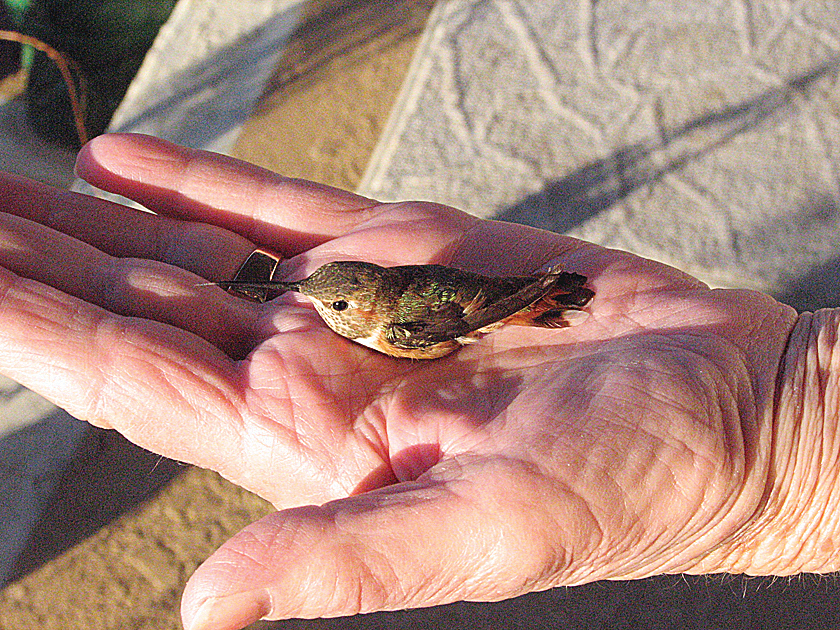
A rufous hummingbird hosts in a host’s hand after being banded and documented in Hampton, Tennessee, several years ago.

Susan enjoyed observing the banding process. “The whole process was surprising,” she wrote to me. “I had never witnessed anything like it.”

Susan said the visiting hummingbird got caught in the trap fairly quickly.

“Bob worked very quickly to measure and band her,” Susan added. “It took about 20 minutes and he fed her three times.”

At the conclusion of the process, she got to hold the tiny visitor. “I have held a hummingbird before, but it was still very special,” Susan said.

She also shared what she termed an “extra story” about hummingbirds.

“About three to four years ago, I was sitting on my deck, watching the babies (immature) hummingbirds buzz around later in the evening,” she said. “They chase each other, and do all kinds of acrobatics.”

During that evening’s antics, one of the hummingbirds flew right into the post used to hold Susan’s feeder.

“It knocked itself out, falling on the railing,” Susan explained. “I was stunned. I picked her up and proceeded to do everything wrong until my son came home. He looked up what to do, and we righted all the wrongs.”

They realized that the bird needed to be fed, so they took down the feeder and fed her twice.

“After that, she took off,” Susan noted. “It was amazing.”

Susan shared that she has been feeding the birds at her home in New York’s Hudson Valley for over 30 years.

“My parents got me interested,” she explained. “They took up bird watching when I was in high school and I have been bird watching ever since.”

Watching birds, she noted, is her all-time favorite thing. “Even when my husband and I are hiking we are always looking for something new,” she said. “It never gets old.”

Photo by Daniel Roberts/Pixabay.com • An adult male rufous hummingbird is a dazzling bird. Many of the winter rufous hummingbirds look much less vibrant.

Through the years, I have seen several of these seemingly out-of-place hummingbirds. Some of them remain at their host’s feeders for a brief stay of a few days or a couple of weeks, but some of these hummingbirds have extended their stay for several months, lingering throughout the winter months before eventually departing in February or March.

The big question concerns whether these hummingbirds are truly lost and out of place. The answer, based on everything I have managed to learn, is that these hummingbirds are precisely where they want to be. For still unknown reasons, some of these western hummingbirds make a migration swing through the eastern United States.

Many of the visiting winter hummingbirds turn out to be rufous hummingbirds, which is a species native to the western United States. The birds visiting at the homes of Katherine, Judi, and Susan all turned out to be rufous hummingbirds. It’s likely the visitor reported by the Storeys was also a rufous hummingbird.

In the summer months, the ruby-throated is the expected species of hummingbird in the eastern United States. In the winter months — not so much. However, in regions all across the Eastern United States, as well as along the Gulf Coast, a few ruby-throated hummingbirds are attempting to overwinter.

The rufous hummingbird has basically become an expected winter visitor each year in Southwest Virginia, East Tennessee, and western North Carolina. A few reports are received each winter. I have observed rufous hummingbirds in many different locations throughout East Tennessee and Southwest Virginia.

Winter hummingbirds, while always a delightful surprise for their hosts, no longer shock long-time birders. We’ve grown to expect them. If any readers are still hosting lingering hummingbirds at their feeders, I’d love to hear their stories. Email me at ahoodedwarbler@aol.com.

Arctic tern migratory champion among world’s birds

September’s arrival puts fall migration into overdrive. The birds that returned this past spring — the warblers, vireos, tanagers, grosbeaks, flycatchers and hummingbirds — have begun or are beginning to make their way back to the locations where they will spend the winter months far from the cold, bleak conditions over most of North America.

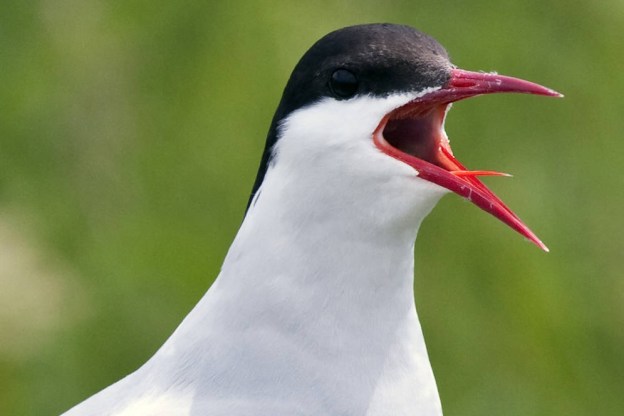
Photo by Jonathan Cannon/Pixabay.com • The Arctic tern outdoes all other birds when it comes to migration. These seabirds journey from their Arctic nesting grounds to spend the winter around the Antarctic, a journey of some 50,000 miles a year.

Some of these birds migrate out of the tropics to avoid competition. Others find North America a land of abundant, albeit temporary, resources. This land of plenty offers a wealth of insects, seeds, fruit and other nourishing, nutritious food to help parent birds keep their strength while they work to ensure their young thrive. Of course, once the bountiful period concludes, they return to the tropics of Central and South America to winter. Those that do so successfully will make the journey back to the United States and Canada in the spring.

The phenomenon of migration isn’t exclusive to the neotropical migrants of the New World. Birds in other parts of the world migrate, too. Waterfowl, shorebirds and raptors are among some of the families of birds that stage impressive migrations.

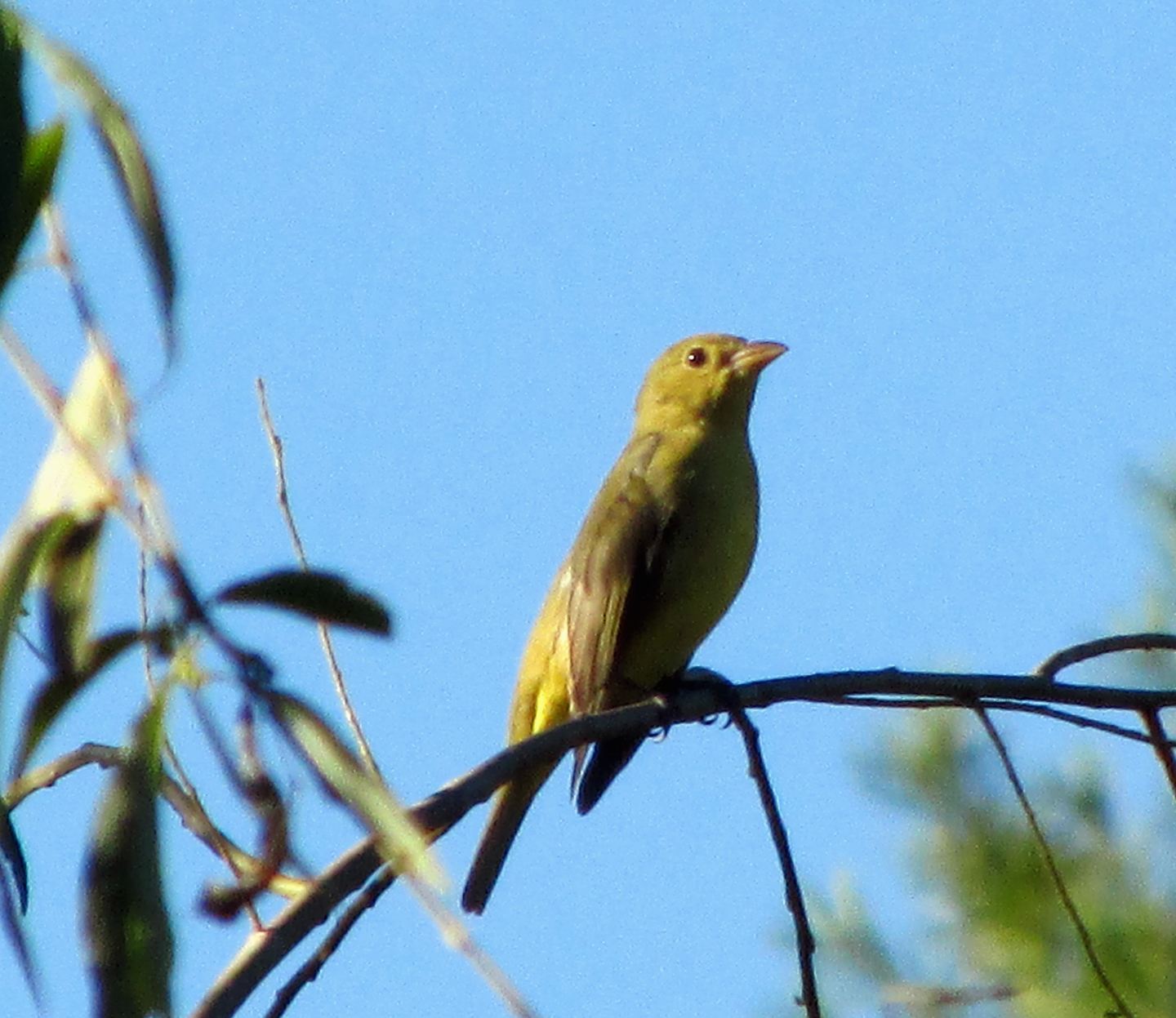
Photo by Bryan Stevens • A female scarlet tanager is a study in contrast from her mate with her dull greenish-yellow plumage being much less vibrant than the male’s bright red and black feathers.

The Arctic tern, for example, truly takes migration to extremes. This small seabird travels each year from its Arctic nesting grounds to the Antarctic region, where it spends the winter months. Put into terms of mileage, the Arctic tern can travel about 50,000 miles in a single year. For a bird with a body length of about 15 inches and a wingspan of about 28 inches, this incredible migration is an astonishing feat. These statistics permit the Arctic tern to easily lay claim to the title of champion migrant among our feathered friends.

According to the website for National Geographic, Arctic terns face a serious threat from climate change. In a profile on the tern at its website, National Geographic warns that Arctic terns are projected to lose 20 to 50 percent of their habitat due to the temperature changes linked to climate change. They also face loss of habitat due to encroachment by human activities such as oil drilling.

The ruby-throated hummingbird, a favorite of many bird enthusiasts living in the eastern United States, makes an impressive migration each year. Just to reach the United States, these tiny birds undertake a strenuous journey. They leave their wintering grounds in Central America to return to the United States and Canada for the nesting season. Most of these tiny birds, which are barely four inches long, make a non-stop flight of more than 500 miles across the Gulf of Mexico. The journey can take almost an entire day. With the end of summer, the entire population of ruby-throated hummingbirds, increased by a new generation of young birds, makes the Gulf crossing for a second time in a year to return to the American tropics for the winter months.

Photo by Bryan Stevens • A ruby-throated hummingbird visits a feeder for a sip of sugar water.

Among North America’s buteo hawks, which includes raptors such as red-shouldered hawk and red-tailed hawk, the broad-winged hawk stands out as a dedicated migrant. These hawks form flocks that at times number in the hundreds or thousands as they sail and glide on thermals rising over various mountain ranges. These hawks and other raptors are well-known in the region for migrating past the Mendota Fire Tower in Southwest Virginia every September and early October.

The broad-winged hawk’s counterpart in the western United States is Swainson’s hawk, which shares the broad-winged hawk’s inclination for migrating in large flocks. Swainson’s hawk is named for William Swainson, the famous 19th century English naturalist for which Swainson’s thrush is also named.

The hooded warbler, my favorite member of the migratory New World warblers, migrates back to Mexico and Central America for the winter months after nesting during the spring and summer in a range concentrated in the southeastern United States. The males, after going quiet in late summer, have started singing on occasion from the shaded woods around my house. I think this has more to do with restlessness as they prepare for to depart on a migration flight that will take them to the balmy Caribbean, Mexico and Central America while we shiver through the months between October and April. It’s not a migration of an incredible distance, but it’s still quite an accomplishment for a bird only five inches long and weighing less than half an ounce.

Photo by Jean Potter • A male hooded warbler flits through the foliage of a rhododendron thicket.

Fall’s a great time to witness the variety of avian life. Look for some of these migrants passing through your yards, gardens or favorite birding spots.

Hummingbirds complete another nesting season before starting south on annual fall migration

Photo by Katy Jefferson/Pixabay.com • A ruby-throated hummingbird sips sugar water at a feeder. During migration, blooming flowers and sugar water feeders are valuable sources of quick energy for these tiny flying gems.

Mildred Wright of Fall Branch, Tennessee, recently shared a story through Facebook about a nesting hummingbird in her yard.

In this photo provided by Mildred Wright, the young hummingbirds can be glimpsed in their nest.

“I discovered this hummingbird nest in a tree in my front yard,” she wrote in a Facebook message. “I have watched mom take excellent care of her babies through some really rough weather.”

She explained that she found the nest on June 8 and has observed as the female hummingbird incubated her eggs and then raised her two hatchlings.

Interestingly, there are a few simple reasons it’s always two eggs for hummingbirds. First, the nest is so small — about the size of a walnut half-shell — that there is barely room for two eggs, let alone more. Second, once the young hatch, the nest has just enough room to accommodate them as they grow, fed well by their mother. Third, feeding two hungry young hummingbirds is a demanding task. A female hummingbird has to find enough food to fuel her own body and help her young in the nest grow and thrive. It’s a full-time job during the daylight hours. She’s pressed hard to succeed at raising two young. Attempting to care for more would most likely prove impossible.

In this photo provided by Mildred Wright, two eggs are shown snug inside the female ruby-throated hummingbird’s nest.

Now that many female hummingbirds are finishing up the task of bringing forth a new generation of hummingbirds, the leisurely fall migration can begin. Hummingbirds are not as frantic about moving south in the fall as they are single-minded about heading north every spring. Numbers of these birds always reach a peak in late summer and early fall at my home, and this year’s shaping up to be a repeat of past ones.

Hummingbird species number around 340, making the family second in species only to the tyrant flycatchers in sheer size. Both of these families consist of birds exclusive to the New World.

With so many hummingbird species, people have been hard pressed to give descriptive names to all these tiny gems. Some of the dazzling array of names include little hermit, hook-billed hermit, fiery topaz, sooty barbthroat, white-throated daggerbill, hyacinth visorbearer, sparkling violetear, horned sungem, black-eared fairy, white-tailed goldenthroat, green mango, green-throated carib, amethyst-throated sunangel, green-backed firecrown, wire-crested thorntail, festive coquette, bronze-tailed comet, black-breasted hillstar, black-tailed trainbearer, blue-mantled thornbill, bearded mountaineer, colorful puffleg, marvelous spatuletail, bronzy inca, rainbow starfrontlet, velvet-purple coronet, pink-throated brilliant, coppery emerald, snowcap, golden-tailed sapphire and violet-bellied hummingbird.

Photo by Peggy_Marco/Pixabay.com • The “Doctor Bird,” which is also known as the swallow-tailed hummingbird, resides only on Jamaica.

Our own hummingbird, which we can claim from April through October every year, is the ruby-throated hummingbird. Ruby-throats are remarkable birds that nest throughout the eastern United States as well as southern Canada. In winter, most ruby-throats withdraw to Central America and Mexico, although a few winter in Florida. They are famous for the amazing feat of crossing the Gulf of Mexico twice each year as they travel to their nesting grounds and then back to their overwintering homes.

Photo by BarbeeAnne/Pixabay.com • The bee hummingbird of Cuba is the smallest bird in the world.

The next generation of hummingbirds always helps swell the number of these tiny birds in our yards in late summer and early fall. It’s our duty as host to keep them safe as they stop in our yards and gardens during their fall migration. Many of the hummingbirds in the fall will be making their first migration, so they will need all the help we can provide to make a successful journey.

Perhaps consider enhancing your plantings of summer flowers while also continuing to offer multiple sugar water feeders. Keep the sugar water mix at a four parts water to one part sugar ratio. Don’t offer honey in your feeders. When mixed with water, it can spoil and spread fungal diseases. Remember that hummingbirds don’t subsist on sugar water alone. They also eat numerous tiny insects and spiders to obtain the protein they need for their dietary needs, so don’t use insecticides near feeders or flowers that hummers are likely to visit.

So, until October frosts eventually drive them out of the region, enjoy the ruby-throated hummingbirds while you can.

Photo by Geschenkpanda/Pixabay.com • The buff-bellied coronet is a hummingbird native to Colombia, Ecuador and Venezuela.

Migrating rose-breasted grosbeaks thrill observers with recent visits

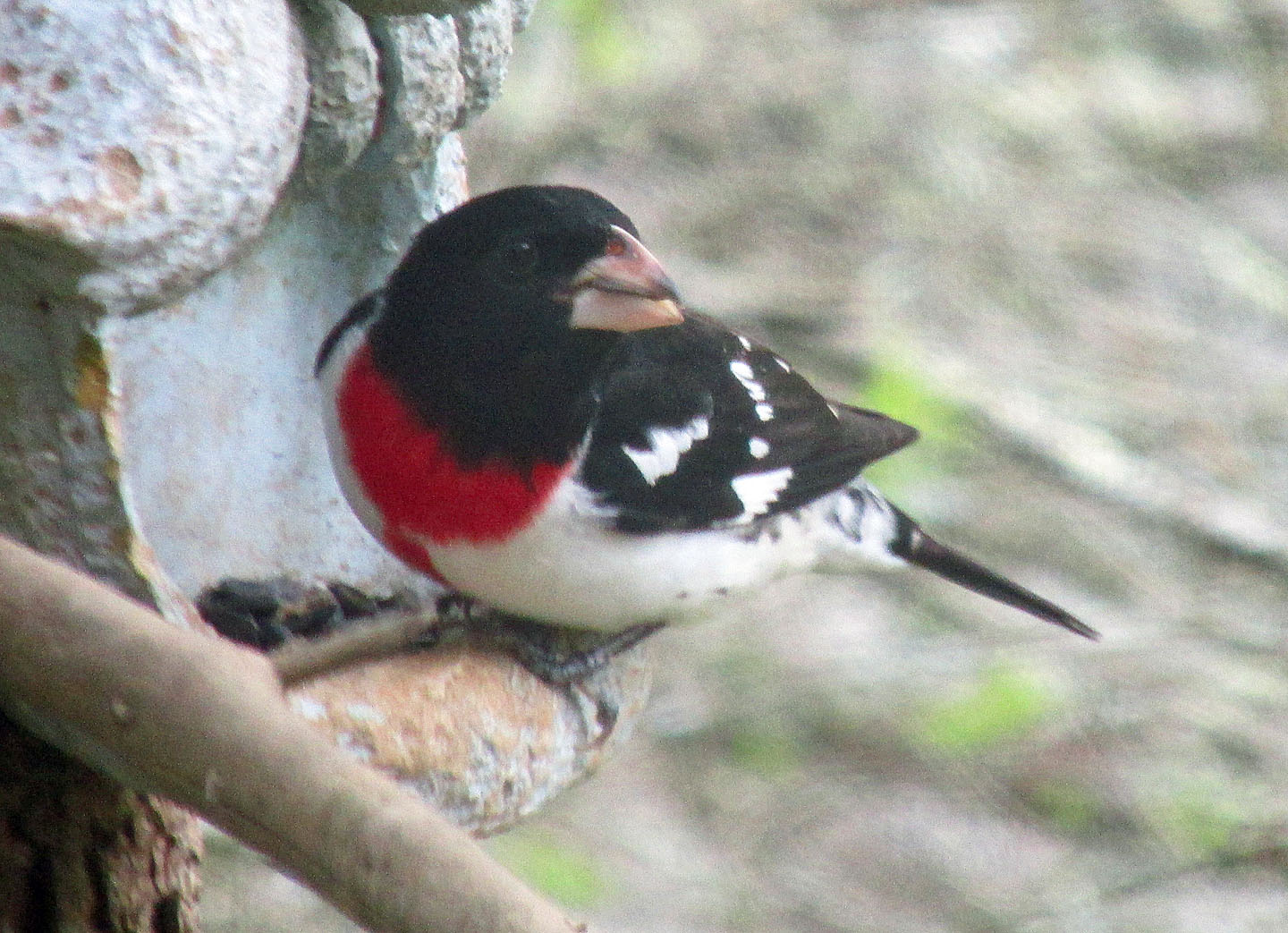
Photo provided by Shannon Stimson • A male rose-breasted grosbeak checks out some well-stocked feeders.

They’re not as dependable as ruby-throated hummingbirds, but they are every bit as impressive. Of course, I am referring to rose-breasted grosbeaks, which have been delighted people across the eastern half of the United States for the past couple of weeks.

Among these grosbeaks, it’s the male that wears the exquisite apparel. Males have a black head, wings, back and tail, with a bright splash of rose coloring across the front of their breast. Males and females exhibit marked sexual dimorphism, which is simply a scientific way of saying that males and females are quite different in their appearance.

The female rose-breasted grosbeak lacks the male’s showy plumage. She could easily be mistaken for a large, chunky sparrow with her brown, streaked feathers. She does have the large beak in common with the male. In fact, the term “grosbeak” is derived from German and simply means “big beak.” Incidentally, I’m told by bird banders that rose-breasted grosbeaks can give a nasty nip with that sizable and sturdy beak.

My email in-box and my Facebook page have been active this migration season with reports from people eager to share observations of these showy songbirds.

Carla Honaker sent me an email on Monday, April 27, about visiting rose-breasted grosbeaks.

“Two days ago I ran out of bird seed and changed from a mix to a black oil seed,” Carla reported. “I had heavy bird traffic yesterday and this morning my mother went over to open the blind that faces the front yard where the bird feeder hangs on a limb in a dogwood tree. To her surprise, there was a rose-breasted grosbeak sitting on the feeder eating the sunflower seeds.”

Understandably, Carla and her mother were very excited to see this unknown visitor at the feeder. Curious about the bird’s identity, Carla used the app Cornell Lab Merlin and made the identification.

Photo by Paintspreader/Pixabay.com • Male rose-breasted grosbeaks provide a jolt of excitement during migratory stopovers in yards and gardens throughout the eastern United States every spring.

Carla said the grosbeak stayed around for a few more minutes, long enough for her to take a picture of the side of his wing and back and tail.

She also had a question, asking if there are many rose-breasted grosbeaks in this area and whether there is a chance he will be a regular at her feeder.

Photo by Bryan Stevens • A male rose-breasted grosbeak perches in a tree on Roan Mountain in Tennessee.

Alas, rose-breasted grosbeaks are usually only spring and fall migrants unless one lives in the higher elevations of some of our local mountains. Visit area mountains in summer if you want to see these birds away from your feeders. They’re still fairly common in the region, but sadly, their numbers have declined overall.

I also let Carla know that grosbeaks are very fond of sunflower seed, so changing the mixed seed to black oil sunflower was probably helpful in attracting the visitor.

Elizabeth “Liz” Wynacht, who lives outside Atlanta in the town of Roswell, Georgia, also shared her own rose-breasted grosbeak story in an email she sent to me on Wednesday, April 29.

Elizabeth provided some interesting background to preface her story. “A few years ago, I looked up and saw this bright red “kiss” on this creamy colored breast of a bird,” she wrote. “I ran in to get my camera but he was gone when I got back. After researching what I thought I saw, my guess was a grosbeak. I have been looking for him ever since.”

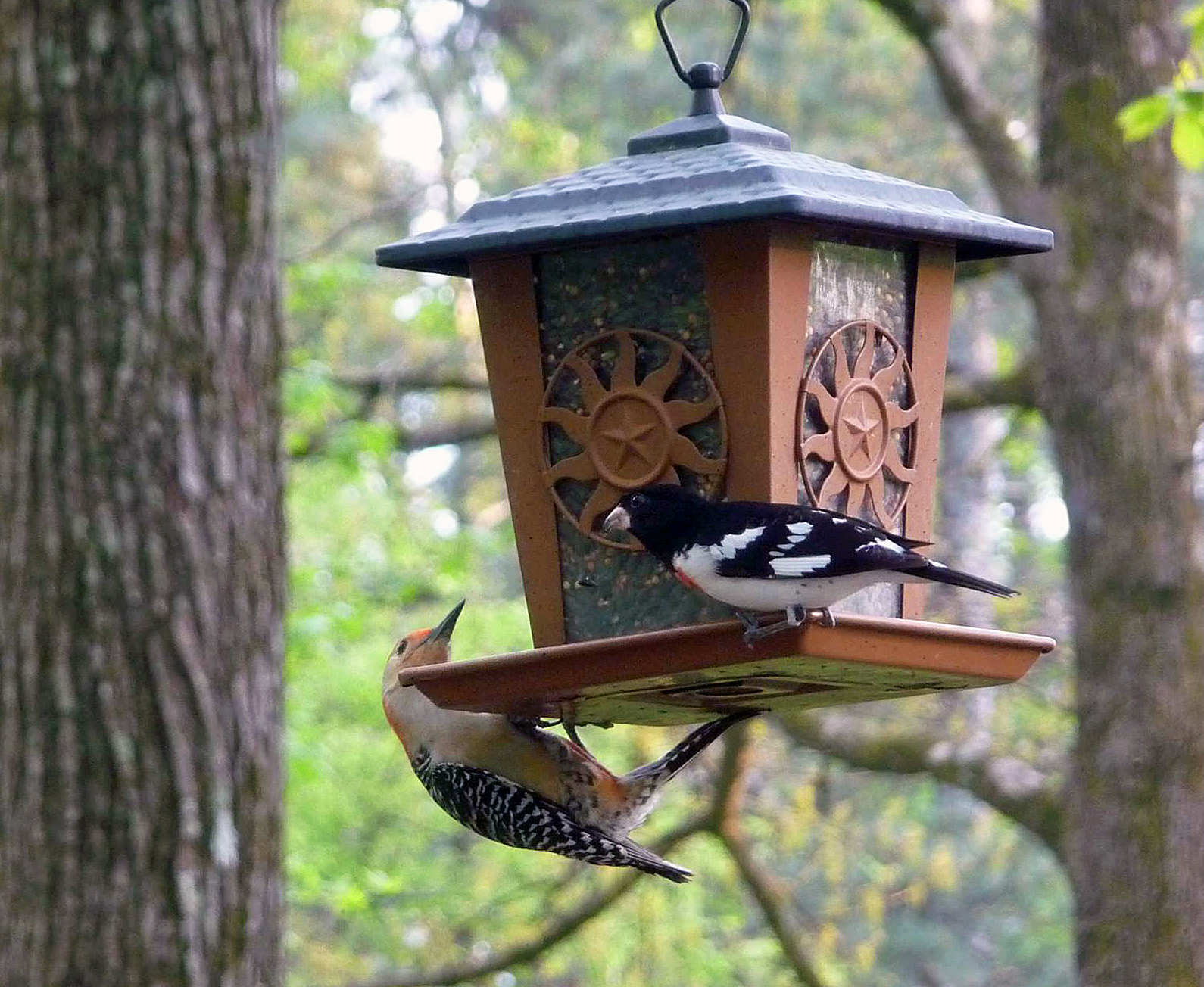
Photo Provided by Byron Tucker • A male rose-breasted grosbeak squares off with a red-bellied woodpecker in the suburbs of Atlanta, Georgia.

After a couple of years, her wait ended. “This past Friday, while sitting on my porch, I looked up from my phone, and I saw that beautiful red kiss coming toward the feeder,” she wrote. “Of course, my movement startled him and he flew away.”

Once again, she fetched her camera and waited. Liz reported that the male grosbeak showed up again along with his little wife. They visited for three days.

“He was a wonderful surprise in the midst of this crazy pandemic,” Liz wrote. “Really lifts the spirit to see such a beautiful bird.”

Shannon Stimson sent me an email on Monday, May 4, with some attached photos of male rose-breasted grosbeaks. “I had three males at my feeders two days ago followed by one female,” Shannon wrote. “One male that looked less mature stayed on for two days gorging on nuts and seeds for hours and engaging in a slight disagreement with a red-headed woodpecker over possession of the feeder.”

Sadly, Shannon reported that the grosbeaks moved on, but noted that their visit brought a great deal of cheer in this isolating time.

Photo by Bryan Stevens
A rose-breasted grosbeak finds a meal of sunflower seeds at a feeder.

Kaylynn Wilster, who lives in Jonesborough, Tennessee, emailed me on Thursday, April 30, about her own rose-breasted grosbeak sighting. “He was not afraid of me and let me walk around the yard,” she wrote.

The very same day that Kaylynn saw her grosbeak, I looked out my window and saw one at my feeders. There had been a storm the previous night, so I suspect that helped “persuade” the bird to visit.

I posted on Facebook about my sighting and several friends shared their own.

“I was just reading an old article of yours about rose-breasted grosbeaks and, lo and behold, I have a flock of them hanging out on my feeders for the first time ever,” wrote Mary Ragland in a Facebook message to me.

Carolyn Grubb in Washington County, Virginia, reported seeing one.

Amy Wallin Tipton, who lives in Unicoi County, Tennessee, reported that her parents had been hosting a male and female rose-breasted grosbeak for the past two days.

James and Pattie Rowland, of Erwin, Tennessee, also reported on Facebook sightings of rose-breasted grosbeaks.

Keep the reports coming. If nothing else, sharing bird sightings is a way to feel less socially distant from others.

Photo Provided by Elizabeth “Liz” Wynacht  • A male rose-breasted grosbeak visits a feeder in a suburban area near Atlanta, Georgia.